

Modern cosmology is remarkably successful within individual observational domains. Galaxy rotation curves, gravitational lensing, supernova distances, and early-universe structure are each modeled with high precision. The difficulty arises not within any single regime, but in moving cleanly between them. Parameters tuned to one domain rarely carry over unchanged to another.
The work summarized here began with a simple question: what happens if we stop trying to explain each regime independently, and instead ask whether the same structural balance appears across all of them? Not as a new force, not as a new particle, and not as a new cosmology — but as a test of continuity.
What emerged is a nine-regime observational suite. Each regime isolates a different observable: motion, formation, geometry, timing, environment, or distance. Each test is deliberately conservative. No new fits are introduced. No parameters are retuned from regime to regime. The goal is not explanation, but constraint: to see whether coherence persists, or whether accumulation, divergence, or breakdown appears anywhere along the chain.
This post provides a single overview of that suite — what was tested, what was observed, and what was not claimed.
9 Regime Table
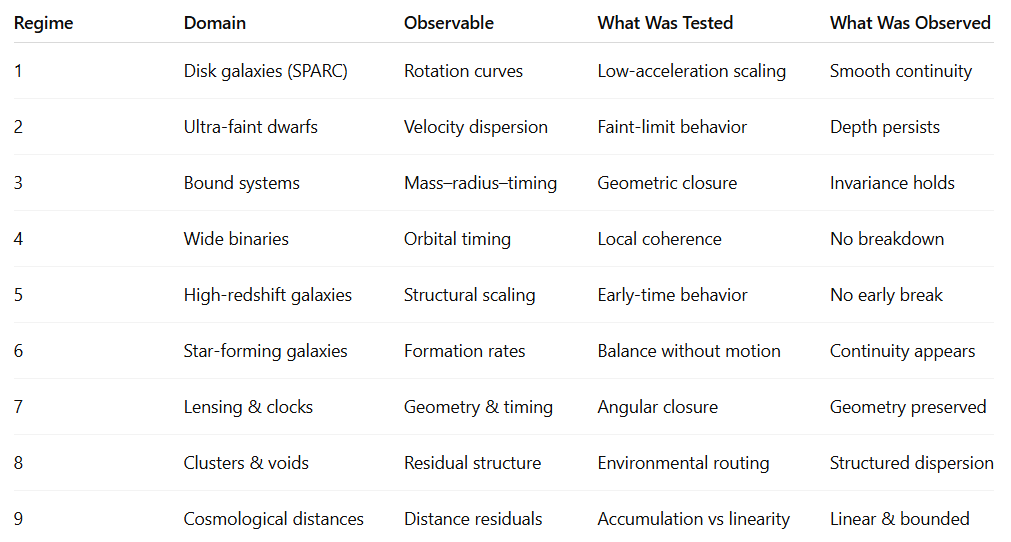
The Nine Regimes — A Structural Map
Regime 1 — Rotation (SPARC Galaxies)
Domain: Disk galaxies
Observable: Rotation curves at low acceleration
This regime examines the well-known regularity between baryonic mass distribution and observed rotational support. Expressed in representational coordinates, the relation is smooth and continuous across galaxy types and scales. No regime boundary appears at low acceleration.
What it shows: Coherence in rotational structure without regime-specific tuning.
Regime 2 — Faint Limits (Ultra-Faint Dwarfs)
Domain: Ultra-faint dwarf galaxies
Observable: Velocity dispersion at minimal baryonic mass
At the extreme faint end, where stochastic effects are expected to dominate, coherence persists. Dispersion remains structurally ordered rather than collapsing into noise.
What it shows: Structural continuity at the faint limit.
Regime 3 — Geometric Closure
Domain: Bound systems
Observable: Mass–radius–timing relations
This regime tests whether geometric relations close consistently without introducing additional bookkeeping. Across systems, closure holds without divergence or accumulation.
What it shows: Geometry remains invariant under scale change.
Regime 4 — Local Timing (Wide Binaries)
Domain: Stellar binaries
Observable: Orbital timing at low acceleration
Wide binaries probe coherence in the weakest gravitational environments accessible locally. Timing relations remain continuous, with no transition to disorder.
What it shows: Structural coherence persists even where local curvature is minimal.
Regime 5 — Early Structure (High-Redshift Galaxies)
Domain: High-redshift galaxies
Observable: Structural scaling at early epochs
At early cosmic times, structure formation is dominated by growth rather than relaxation. Yet scaling relations align smoothly with those seen locally when expressed representationally.
What it shows: No early-time break in structural coherence.
Regime 6 — Formation Without Motion (Star Formation Continuity)
Domain: Star-forming galaxies
Observable: Star formation rate normalized by mass and scale
This regime removes motion entirely. Formation is treated as a rate of emergence rather than a dynamical response. Even here, the same balance appears.
What it shows: Structural coherence does not depend on motion.
Regime 7 — Geometry and Time (Lensing and Clocks)
Domain: Strong gravitational lensing and time delay
Observable: Angular closure and timing consistency
Multiple light paths and timing delays must close simultaneously. Geometry is preserved exactly, while mass inference remains non-unique.
What it shows: Geometry is conserved; mass bookkeeping floats.
Regime 8 — Environment (Clusters and Voids)
Domain: Large-scale structure
Observable: Residual structure under environmental stratification
Dense and sparse environments route representation differently along observational paths. Dispersion is structured, not random, and does not average away when paths are mixed.
What it shows: Environment reshapes inference, not coherence.
Regime 9 — Drift (Distance Residuals)
Domain: Cosmological distances
Observable: Distance-modulus residuals vs effective path length
Residuals remain linear, bounded, and environment-conditioned. No curvature or runaway accumulation appears. Reciprocity is preserved.
What it shows: Linearity without accumulation.
What All Nine Regimes Share
Across all nine regimes:
Coherence persists.
No uncontrolled accumulation appears.
No regime requires retuning parameters introduced in another.
No transition to disorder is observed.
Geometry, timing, and structure remain admissible.
What never appears is just as important:
no divergence at low acceleration,
no environment-independent drift,
no breakdown of reciprocity,
no need for regime-specific corrections.
The same structural balance expresses itself through different observables, depending on what can be locally represented.
This Work Shows What Cannot Be Sustained by Observation
This suite does not propose:
a new force,
a modification of general relativity,
a replacement for cosmological expansion,
or a complete theory of the universe.
It does establish:
a set of empirical constraints,
a continuity that spans galactic to cosmological scales,
and a representational interpretation in which accumulation is forbidden.
Multiple cosmological models can coexist above this layer. The results here do not choose between them. They restrict what any such model can do without violating observed continuity.
Such cross-regime continuity without retuning is uncommon in astrophysics.
Data and References
The complete nine-regime observational test suite, including raw data, provenance, and invariant checks, is archived publicly on Zenodo:
https://doi.org/10.5281/zenodo.18274006
A constraint-based interpretation of astrophysical scaling relations, developed in parallel and consistent with the continuity framework summarized here, is available at: https://zenodo.org/records/18368450
Individual regime discussions and conceptual orientation are available on this Substack and at the Heart of Aletheia website.